Almost a year ago, I was incredibly fortunate to sign with Ann Rose at The Tobias Literary Agency. Becoming a Rosebud Author was a dream of mine for quite some time, and I’d be lying if I said I don’t still pinch myself, wondering if it was all a dream.
But my journey to Ann wasn’t linear, and it certainly wasn’t easy. It took nearly two hundred rejections, a few leaps of faith, and many instances of luck, perseverance, and flat out stubbornness.
I wrote all about my process on Medium, and if you’d like to hear more about my journey toward finding a literary agent who is an undeniable champion of my work, please click below to continue reading about how I went from floundering in the query trenches to signing a contract in a matter of days.
Despite living in a suburb that is only 25 minutes from a major city, our back yard leads into a magical, untouched forest. There are no trails there—it’s town reservation land—so we often take walks in there to explore.
It’s quite a magical place, these woods. Although there are houses just 50-100 yards away, it feels as though there is no one around for miles, and it doesn’t appear that many (if any) other people go in there. When it snows, the only foot prints are animal tracks. When the ground is clear, we have to very carefully pick our way through brambles and climb over downed logs—it’s a true nature adventure right beyond our back fence.
In the winter, we follow trails of deer and coyote prints through silent, freshly fallen snow. There have been times we’ve walked in and are met with a dozen or more white tails bouncing away. A magical place indeed, and we are so lucky to have such easy access to it.
Once when my daughter was five, she and I were exploring just before dusk. We made our way back to a rock wall that crosses the woods, and based on the fact that our house was built in 1915, I’d guess that this rock wall is at least that old as well. As we approached the wall, we both stood silently as the forest settled around us. I suggested to my daughter that maybe the rock wall was the entry way to the fairy forest, and the wonder that washed across her face was pure magic.
She let this sink in for a moment, then she turned toward me as her face became very serious.
“Do you think we’ve gone too far?” she whispered.
The gravity with which she said this far surpassed her five years, and while it was funny and cute, it also gave me pause. It’s so easy to take a walk through the woods and notice the shapes of trees, find rocks to climb, and listen for the scampering of little feet through the leaves. But what we often forget is that children do this and so much more.
To a child, a rock wall is not just a beautiful old structure. It’s full of wonder and what-ifs and more questions than can even be asked. A giant rock is not just something to climb on. It’s a mountain, a fortress, a castle in the sky.
Did I think we’d gone too far? No, of course not. But to her, the expanse of forest that stood before us was larger than life. It was mystical and unknown—and probably a little bit scary. We decided to turn back that day, I could sense her nervousness and wanted to keep the woods a happy place for us—a place for adventure and curiosity, not fear.
Ever since then, I think about this moment when we go into the woods. We go further now—she’s nearly seven, and we’ve been beyond that rock wall many times. It’s no longer a spot that makes her nervous, but she still has the same sense of wonder, and the adventures we have in those woods are still just as magical as they were the first few times we explored.
And as a writer, I try my hardest to go beyond simply noticing. I try to go beyond the bird calls, the chipmunk chatter, the rustling of leaves. I look for the magic—the rock with two perfectly heart shaped holes in it. The giant crater-like hole in the earth, the vines that climb up trees, inviting a treetop adventure, the mysteries and questions surrounding the rock walls that twist through the woods like ancient snakes frozen in time.
Because life, and writing, is about so much more than noticing. If we can imagine beyond what we can see, the magic and wonder is all right there in front of us. So do more than notice. Ask questions, wonder the what-ifs, find the magic in every day life, and try to do this all as if through the eyes of a child.
And if you ever need to ask yourself “have we gone too far?” know that you’re probably exactly where you’re supposed to be.
Last year, I wrote one goal to begin the year. One.
And what that goal was probably won’t be a surprise to anyone in the writing community:
Sign with an agent.
That was it. Sure, I had lots of other things I wanted to accomplish, but that was the only one I wrote down. That was the only one I quantified and put up on a pedestal of my skill, my value, my worth as a writer.
And when the year ended and I had not yet signed with a literary agent? Well, logic would say that I failed. But the more I think about it, the more I beg to differ.
Sure, I didn’t sign a contract. But there are so many things (so many!!!) that I did accomplish.
I completed and polished many picture book manuscripts. Some that are not so great, sure (hey, they can’t all be winners), but many of these I am so very proud of. These stories come from my heart and soul, and I know that this is what I am meant to be doing.
I entered contests— and even won a few. Yes, the prizes gained from these contests may be “less than” an agent contract on paper, but I assure you, each of these was an integral piece of my personal journey, and that is invaluable.
I was selected as a Write Mentor mentee in the summer program. I spent 4 wonderful months working on various PB manuscripts with my mentor. I grew leaps and bounds during this time, but the best part about it? I ended up with a lifelong friend and mentor, and an undeniable champion for my writing. Priceless.
I put my work out there— a lot. Agent submissions, writing contests, critique opportunities, Twitter pitch events, live pitch events— you name it, I did it. And by doing this, I opened myself and my writing up to a whole world of knowledge, support and growth by all of these unique facets of the writing community. I have no doubt that each one of these helped me grow in various ways, whether “successful” or not. Oh, and that mentorship mentioned above? That was a direct result of taking risks and putting myself out there. It’s worth it, trust me.
I completed drafting my first MG novel, and I am extremely, ridiculously, shout-from-my-rooftop proud of this. Maybe it will get published, or maybe it will never see the light of day, but my gosh— I did it. And the most wonderful thing about completing this draft is the realization that something that scared me so much was actually well within my reach.
Looking back, it hit me when I saw a tweet recently (and I’m so sorry that I can’t credit who it was here, I do not remember exactly who said it) about only making goals about things that are within our control. It’s simple logic, really, and something I do in my “real” life already. Signing with an agent is not at all within my control. Signing a book contract is not at all within my control.
What is in my control? Working on my craft. Continuing to write. Continuing to put my work out there in every way that I can, and continuing to work with my critique partners and critique groups every chance that I get. I can research agents and submit to those whom I think would make a good fit, but when it all comes down to it, I have zero control over whether any of them will feel the same way.
So my goals for this year? They’re all about me and my work. The rest will come when it’s time. I just have to trust the process and do everything I can to keep improving. But the key words here are “I can.” If it’s out of my hands, it’s off my goal list. Period.
Recently, I completed my first NaNoWriMo (or National Novel Writing Month challenge, for those who aren’t familiar).
The general challenge is to write 50,000 words of a novel within the 30 days of November. Many people stick with the 50k, and many choose to set their own goals or standards for the month. As I was going into this attempting to draft my first middle grade novel, I had no intentions of hitting the 50k mark when I set out. My goal was 30k, and even that seemed incredibly daunting to someone who has been writing only picture books up until now— each of those coming in somewhere around the 500 word mark.
30,000 words? Was that even possible at all? Let alone in one month?
But I had a MG idea that had been poking around in my brain for about a month or so, so I figured— why not now? Why not give it a shot? I was comforted by the fact that if I “failed”, I would still be winning if I got any words down on the page at all. Writing is writing, no matter how much or how little.
Throughout the process, I learned a lot about myself, my writing process, and writing in general. But there were 6 main takeaways that really stuck with me.
My competitive nature kicks in even when I have no one to compete against.
Even though I told myself that any amount of words would be winning, once I got started, I became almost obsessed with watching my word count rise on my NaNo landing page. I am not necessarily saying that this is a good or bad thing— it was incredibly motivating, to say the least.
I came out of the gate hot. I had 5k words in the first couple days, 10k words written in my first week. At that point, I could see that 30k was entirely possible, and I started thinking that I could end up with more than that. I began to realize that I could quite possibly finish a rough draft in it’s entirety, seeing as MG is often below 50k anyway.
The funny thing that I never expected, though, was that logging in and seeing that general 50k goal kind of tripped something in my brain. When I typed “The End” on my novel at around 37.5k words, I gave myself a few days off to relax and decompress. But during that time, I couldn’t get 50k out of my brain. I had another MG idea that I had written a very rough outline of at the start of this. So, with that competitive nature drilling the goal of 50k into my brain every day, I decided to dig back in. I had about two weeks left in November, I figured, so why not go for it?
And I did just that. I pushed and pushed— those last 5,000 words were a battle, let me tell you. But my brain wouldn’t rest until I hit 50k. And as soon as I hit about 13k words on my second novel to pass my goal, it felt really, really good. I will also say, though, that once I hit that goalpost, it was almost like my brain shut off. I haven’t touched the second manuscript since.
Novel writing is exhausting.
As someone who has been writing only picture books prior to this, I knew that the idea of writing a novel was daunting. What I didn’t realize was how mentally and physically exhausting it would be to write that much in one month. Not only did I give myself a hardy flare up of carpal tunnel syndrome and epicondylitis from typing so much, but I found myself mentally drained at the end of some days. Sections of my book that were more emotionally charged left me drained as if I lived through them instead of my characters. Sometimes this was a lot to handle. But other times? Reliving that electric rush of a first crush or first kiss? Those days were exhilarating.
A deadline is my best friend.
Could I sit down and write 50k words every single month? Absolutely not. The single factor that kept driving me forward was the “official” deadline of NaNo. I started out with a goal to write at least 1,000 words every single day, and surpassed that goal every day until the second half of the month. I don’t think that in my normal life, I have the physical or mental energy to write that much every single day— weekdays and weekends with no breaks, without a deadline driving me forward. I suppose I thrive under pressure, which, looking back on it, is how I always approached projects in school and work as well. So this was really no surprise.
I need to do what works for me, even if it seems a little backwards.
Do a character study before you being writing, they say. Outline your plot, do your research.
I did none of this. I had a general idea of who each character was and a general idea of the plot/arc. But what I didn’t even think about at first were the intricacies, the sub-plots, how I would get from point A to point B. What I did instead was mini outlines at various points throughout the process. I wrote to a certain point, then would pause and take notes on what would happen if X did Y? What if Z was there instead? I have a notes document that is full of question marks, unfinished statements, and plot ideas. But every time I stopped for a mini-outlining session, I would organically realize where the plot and characters were supposed to go. I never would have come up with these things if I tried to plot it out, chapter by chapter, at the very beginning.
The thing is, detailed plotting ahead of time and massive preparation does work for some people. But I know now that it’s not the only way.
I can do hard things.
This is one of my most valuable takeaways from NaNo. I can do hard things. I can do things that scare me. I can do things that take me so far out of my comfort zone, I might as well be orbiting Mars. And that is something that is more empowering than words can really capture. I never thought I could write a novel before this, and now I have one drafted that I’m incredibly proud of. It still needs a lot of work, but it’s a story that I love with characters that I love even more. This is a huge win, and gives me an enormous amount of motivation to keep going.
Flow is a real thing.
There were days during this process that I wrote 3,000, 5,000, up to 7,000 words in one day or one sitting. And most of the time, I was not slogging though or checking my word count like I often do while writing articles, for example. I found myself getting so into character, so in the zone that I would look up and an hour would have passed suddenly.
My highest word count in one day was over 7000 words, and that was a day where I wrote through a portion of the story that I was so excited to arrive at. Once I started, I went completely into a zone as if I was living through the story myself. That 7k felt like it went by in a flash, when in reality, it took me around 5 hours of work. The only thing I can compare it to is a runner’s high, and it is really, truly incredible.
Overall, I am so glad that I decided to throw myself into NaNo. If I had taken the time to think about it too much, or allowed myself to be too intimidated by my lack of preparation, I wouldn’t be sitting here today with a completed draft. It’s not perfect, by any means, but that’s what the next several months are for. NaNo was just the catalyst, the explosive reaction that laid it all out on the page. The magic will come in revision, and hopefully, this story will turn into one that you can buy on the shelves someday.
We moved into a new house last summer, one with a spectacular garden to tend. This spring has been an exciting time, walking around almost daily, seeing what types of plants, flowers, herbs, and vegetables are growing and blooming. There are bunches upon bunches of lilies, endless fennel, thyme and sage. We have rhubarb, hyacinth, lilacs and fruit trees, and many things that I have yet to identify.
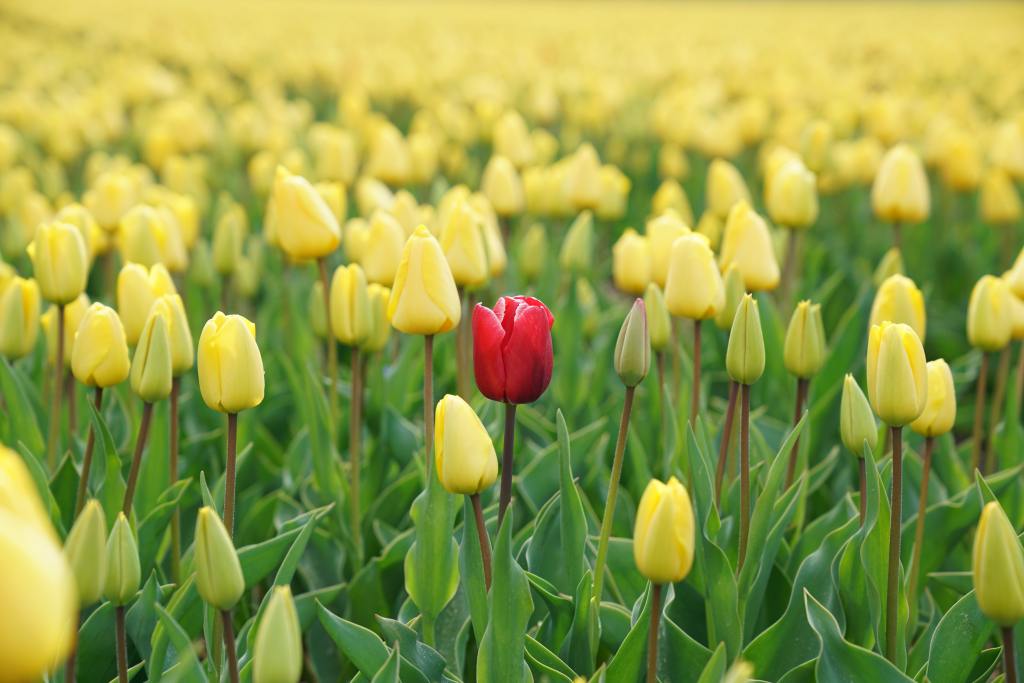
Recently I was making my rounds, inspecting all of the different sections of the garden, searching for new buds and blossoms, when something red caught my eye. A singular red tulip amongst a large bunch of lilies beneath the pear tree.
Tulip bulbs are meant to be planted each fall to grow the following spring. We didn’t plant any tulips in the fall, certainly not right in the middle of the lilies. It’s no big mystery how it got there, it must have self seeded from tulips that were grown by the previous owners, or perhaps a neighbor’s yard, the wind carrying the seed to rest in our garden.
The point is not how it got there. The point, and my interest in this tulip comes from the singularity of it. We are used to seeing tulips in bunches, reds and yellows and oranges, striking and bright, early colors in spring bloom. This lone tulip is a single drop of red in a sea of green leaves and weeds, and is so vibrant that it stands out even more than the many hyacinth close by.
As a writer, it’s so easy to get caught up in feeling like you’re in that swath of green that surrounds the tulip. Each writer using their words to reach the same or similar goal, it can feel like we have no way to stand out from the rest of the garden. Sometimes we get stuck in the weeds, drafting, revising, querying. We get tangled in the sameness that being a writer feels like, identical ants marching along to one singular destination.
It’s easy to forget that we all have our own story to tell. Our ideas and experiences are unique. We self seed these ideas, letting them grow and flourish, at first amongst the weeds and endless tangles of greenery. Yet eventually they will emerge, vibrant, stunning, glowing with red against a green landscape.
Sometimes these ideas surprise even us, as we break apart from the crowd around us, yet remaining encompassed by the beauty of their leaves and blossoms. Our words and our stories are singular, yet they thrive among the community of the rest of the garden.
In short, be the tulip. Find your comfort nestled in among the forest of green, and when it’s time, emerge with your red, your idea, your words. A singular tulip in the garden, beautiful, breathtaking, unique, but not at all alone.



 stephanierondeauwrites.com